Agentic AI vs Traditional Chatbots: What Your Business Actually Needs in 2026
Not every business problem needs an AI agent — and not every "agent" pitch is one. Here's a clear, no-hype breakdown of when a simple chatbot is the smarter choice and when you genuinely need agentic AI.
Introduction
"Should we build a chatbot or an AI agent?" is one of the most common questions businesses ask before starting an AI project in 2026 — and it's also one of the most commonly answered wrong, in both directions. Some teams overpay for a full agentic system when a simple FAQ bot would have solved the problem in a week. Others bolt a basic chatbot onto a workflow that genuinely needed multi-step reasoning and integration, and then wonder why it never delivers real value.
This isn't a "which is better" question. It's a "which fits your actual workflow" question — and answering it correctly before you start building can save months of rework and a lot of budget.
What a Traditional Chatbot Actually Is
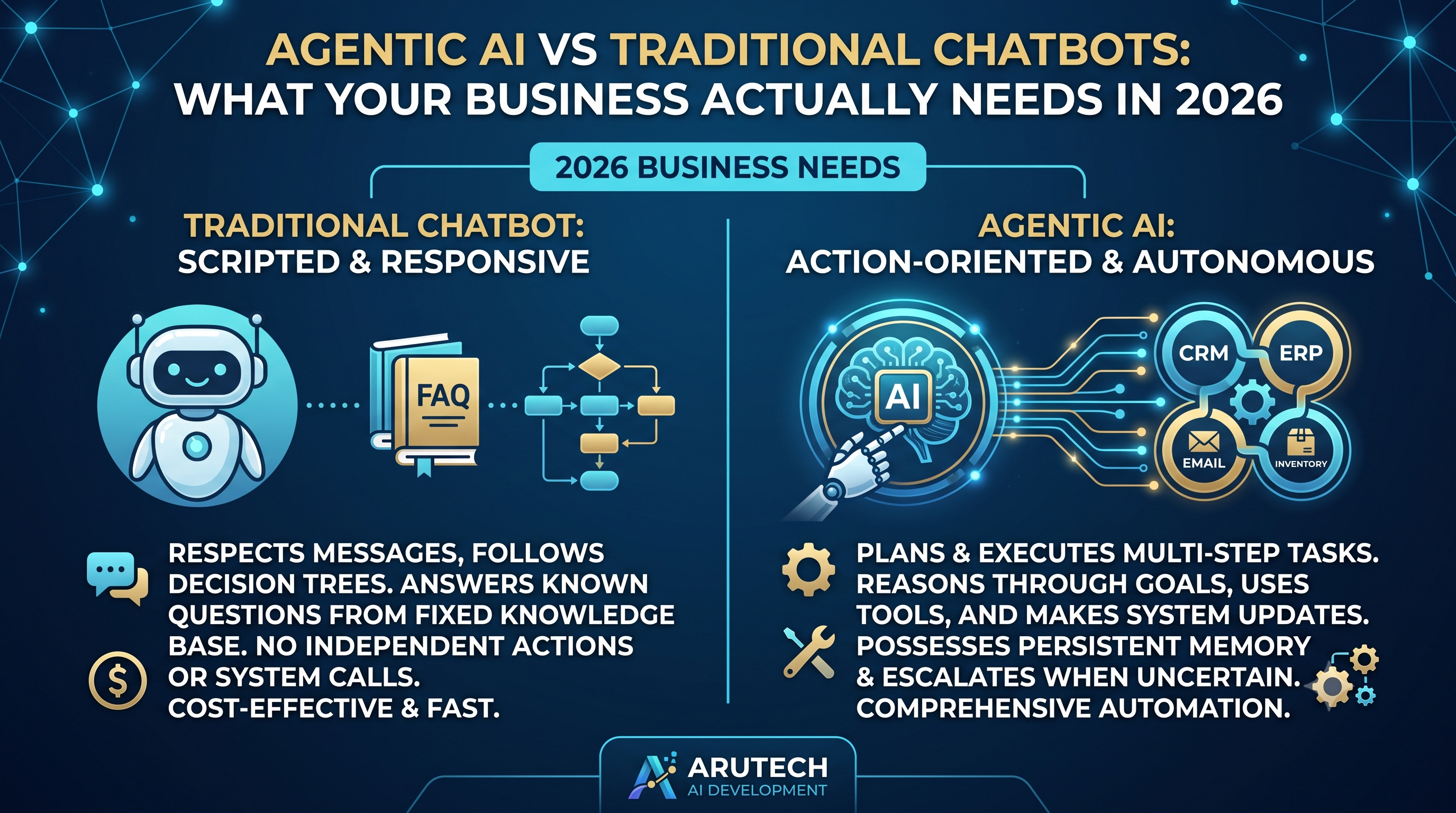
A traditional chatbot is built around predictable, scripted interaction. Even the more advanced LLM-powered chatbots still follow the same basic pattern: receive a message, generate a relevant response, done. Common characteristics:
- Answers questions from a fixed knowledge base or FAQ set
- Follows decision-tree or intent-based logic for structured tasks (booking a slot, resetting a password)
- Has no persistent memory of goals across a multi-step task
- Cannot independently decide to call an external system unless that exact path was explicitly programmed
Chatbots are simple, fast to deploy, and — this matters — cheap. For a huge number of business use cases, that's exactly what you need.
What Agentic AI Actually Is
An AI agent is built to act, not just respond. It can:
- Break a goal into a sequence of steps on its own
- Call tools, APIs, and systems to actually complete parts of a task
- Carry context and memory across a task that unfolds over multiple steps or even multiple sessions
- Recognize when it's uncertain and escalate to a human instead of guessing
The difference isn't "smarter language model." Both chatbots and agents can run on the same underlying LLM. The difference is architecture: what the system is allowed to do once it decides what needs to happen.
Side-by-Side Comparison
| Traditional Chatbot | Agentic AI | |
|---|---|---|
| Core behavior | Responds to a message | Plans and executes a task |
| Handles multi-step workflows | No | Yes |
| Calls external tools/APIs | Limited, pre-scripted | Dynamic, decided in real time |
| Memory across a task | Minimal or none | Persistent, often with a memory layer |
| Best for | FAQs, simple triage, structured forms | Back-office automation, multi-system workflows, judgment-based tasks |
| Typical build time | Days to a few weeks | Weeks to a few months, depending on integrations |
| Typical cost | Lower | Higher, scales with integration complexity |
| Risk if it's wrong | Low — a bad answer, easily corrected | Higher — a wrong action can have real consequences |
When a Chatbot Is Genuinely the Right Choice
Don't let anyone talk you into an agent build if your actual need looks like this:
- Answering the same 30–50 customer questions on repeat
- Collecting structured information through a guided form-like conversation
- Triaging incoming requests into the right queue or department
- Providing basic product or policy information without needing to touch other systems
If the task is fundamentally "give the right answer to a known question," a chatbot solves it faster, cheaper, and with less risk than an agent — and adding agentic complexity here is usually just overengineering.
When You Actually Need Agentic AI
The signals that point toward an agent, not a chatbot:
- The task requires touching more than one system to complete (checking inventory and updating a CRM and notifying a supplier)
- The workflow has multiple steps that depend on the outcome of the previous step
- The task benefits from remembering context across a longer interaction, not just one exchange
- You want to reduce manual back-office work, not just deflect front-line questions
- The volume and complexity of the task make a human doing it end-to-end genuinely expensive
Common 2026 examples: automated invoice processing and reconciliation, multi-step customer support that requires pulling from several internal systems, sales lead qualification that checks multiple data sources before scoring a lead, and supply chain workflows that adjust based on real-time inventory data.
A Simple Framework for Deciding
Ask these three questions about the workflow you're trying to solve:
- Does it require more than one system to complete the task? If yes, lean agent.
- Does a wrong answer just need correcting, or does a wrong action cause real downstream cost? If the latter, you need the governance and testing rigor of a proper agent build, not a quick chatbot.
- Would a skilled employee doing this task need to remember context from five minutes ago to do it well? If yes, you need memory — which points to an agent.
If you answered "no" to all three, a well-built chatbot is very likely the right — and cheaper — choice. If you answered "yes" to two or more, agentic AI is worth the additional investment.
Why Getting This Decision Right Matters for Your Budget
The cost gap between a chatbot and an agentic system isn't small, and it isn't just about the initial build. Chatbots are largely "set and maintain." Agentic systems need ongoing monitoring, testing for edge cases, and governance as they touch more of your real infrastructure. Choosing the wrong tier isn't just inefficient — it's either overpaying for capability you don't need, or underbuilding something that quietly fails at the exact moment it matters most (a wrong inventory update, a missed compliance step, an incorrect customer commitment).
How Arutech Helps You Choose
We don't start every AI conversation by pitching an agent. Our AI & Generative AI Development team scopes the actual workflow first — what systems it touches, how much judgment is involved, what happens if it goes wrong — and recommends the right tier of solution, whether that's a focused chatbot, a single AI agent, or a coordinated multi-agent system. The goal is a system that matches the problem, not the most impressive-sounding build.
Explore Arutech's AI & Generative AI Development services →
FAQ
Can a chatbot be upgraded into an AI agent later?
Sometimes, but not always cleanly. If there's a real chance your needs will grow into multi-step, multi-system territory, it's worth building on an architecture that can extend into agentic capability later, rather than starting from scratch.
Is agentic AI always more expensive than a chatbot?
Generally yes, because it requires more integration work, more testing, and more governance. But the right comparison isn't cost alone — it's cost against the manual work or business risk the agent is replacing.
What's the biggest mistake businesses make in this decision?
Choosing based on what sounds impressive rather than what the workflow actually needs. A well-built chatbot solving a real problem beats an over-engineered agent solving a problem nobody had.
Do agentic AI systems still need human oversight?
Yes, especially for high-stakes or ambiguous decisions. The best agentic systems are designed to know when to hand off to a person, not to remove humans from the loop entirely.
Want to work with Arutech?
We build AI, apps, and digital marketing strategies that drive real results.
Get a Free Consultation