How to Choose the Right AI Agent Development Company in India (2026 Guide)
Most "AI agent" vendors are just chatbots with a new label. Here's exactly what to check — architecture, memory, security, and pricing — before you hire an AI agent development company in India.
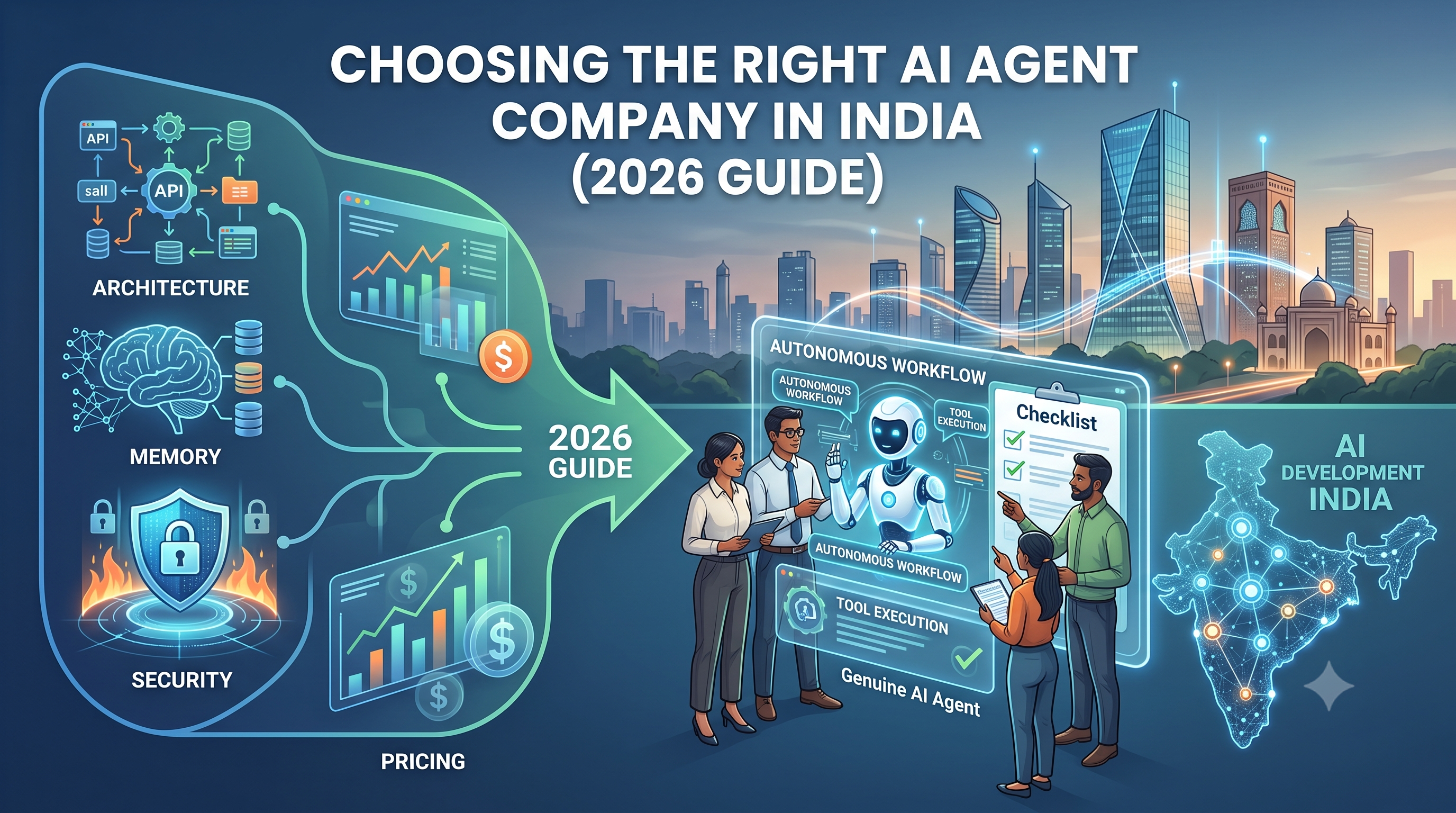
Introduction
Every second vendor pitch you get in 2026 mentions "AI agents." Half of them are chatbots with a new label. The other half genuinely build autonomous systems that can plan, execute, and hand off work without someone babysitting every step.
If you're evaluating an AI agent development company in India, the gap between those two groups is the single biggest factor in whether your project ships something useful or a demo that never survives contact with real customers. This guide walks through what actually separates a serious AI agent development company from a rebranded chatbot shop — so you can ask the right questions before you sign anything.
What "AI Agent" Actually Means in 2026 (And Why It's Not a Chatbot)
A chatbot answers. An AI agent acts.
The distinction matters more than it sounds. A chatbot takes a message, generates a response, and stops. An AI agent can:
- Break a goal into steps on its own ("check inventory, then draft a reorder, then notify the supplier")
- Call tools and APIs to actually do things — not just describe what should happen
- Hold context and memory across a task that spans minutes, hours, or days
- Decide when it needs a human to step in, and hand off cleanly instead of guessing
By 2026, businesses across finance, healthcare, retail, and manufacturing have moved past the "should we try AI agents" question. The real question now is whether they're deployed as isolated point solutions or as coordinated systems — multiple agents that plan, execute, and check each other's work the way a small team would. That shift is exactly why the vendor you pick matters so much: building a single well-behaved agent is a very different engineering problem than building an agent ecosystem that's secure, auditable, and doesn't fall over the first time it hits an edge case.
What to Look For in an AI Agent Development Company
1. Tool-native architecture, not just prompt engineering
Ask directly: "How does your agent take action in the real world?" If the answer is entirely about prompt design and conversation flows, that's a chatbot vendor in agent clothing. A tool-native agent is built around structured, well-documented APIs it can call — your CRM, your inventory system, your calendar, your payment gateway — with proper error handling when a call fails. The "brain" (the LLM) is actually the smaller part of the engineering problem; the tooling layer around it is where most of the real work happens.
2. A real memory layer
Agents that forget everything between messages can't handle multi-step work. Ask whether the company builds a proper memory architecture — typically a vector database or similar retrieval system — so the agent can recall relevant context from earlier in a task, or from your company's own documents, without you re-explaining everything each time.
3. Security and governance built in, not bolted on
An agent that can take actions is also an agent that can take the wrong actions at scale. A serious vendor should be able to explain:
- What permissions the agent has, and how those are scoped
- How sensitive data is handled and where it's stored
- What audit trail exists if something goes wrong
- How the system behaves when it's uncertain (does it ask, or does it guess?)
If a vendor can't answer these clearly, that's a red flag regardless of how good their demo looks.
4. Multi-agent thinking, even if you only need one agent today
Even simple use cases benefit from architecture that can scale into multiple coordinating agents later — one to triage, one to execute, one to verify. A company that only knows how to build single, monolithic bots will struggle when your needs grow past the first use case.
5. Transparent, realistic pricing
AI agent development pricing in India varies enormously — from a few hundred dollars for a narrow prototype to well into six figures for enterprise-grade, multi-agent systems with compliance requirements. Be wary of vendors who quote a flat number before understanding your data sources, integration complexity, and compliance needs. A credible AI agent development company scopes based on the specific workflow, not a one-size-fits-all package.
Red Flags to Watch For
- "Our AI agent can do anything." No serious agent is unbounded. A good vendor will tell you what it's not good at yet.
- No mention of human-in-the-loop. Even the most advanced agents in 2026 still need clear escalation paths to a person for ambiguous or high-stakes decisions.
- Reluctance to discuss failure modes. Ask "what happens when this breaks?" If they don't have an answer, they haven't built one in production.
- A portfolio full of screenshots, not live systems. Ask to see something actually running, or at least a recorded walkthrough of real usage, not a mockup.
Questions to Ask Before You Sign
- What tools and systems will the agent actually integrate with, and how?
- How is memory handled — session-only, or does it persist and learn over time?
- What's your process for testing an agent before it goes live with real customers or real data?
- Who owns the code, the data, and the infrastructure once the project is delivered?
- What does ongoing support and iteration look like after launch?
Why This Matters More in India Specifically
India's AI agent development market is growing fast, and that growth has brought a wide range of vendors — from single freelancers offering "AI chatbot" packages to teams building genuine agentic systems for global clients. Cost expectations also vary widely by city and team size, so the cheapest quote and the most capable team are often not the same company. Take the time to see real, working systems rather than pitch decks, and prioritize vendors who can clearly explain the engineering behind the agent, not just the story around it.
How Arutech Approaches AI Agent Development
At Arutech, our AI and Generative AI Development practice is built around exactly the criteria above: tool-native agents with proper API orchestration, memory layers using vector databases, and security-first design — not chatbots wearing an "agent" label. Whether you need a single customer-support agent or a coordinated multi-agent system for back-office automation, we scope the architecture around your actual workflow before writing a line of code.
Explore Arutech's AI & Generative AI Development services →
FAQ
What does an AI agent development company actually build, if not a chatbot?
A system that can take multi-step action using real tools and APIs — not just generate conversational replies. Think of it as automating a workflow end-to-end, with a human able to step in only when needed.
How much does AI agent development cost in India in 2026?
Costs range widely depending on scope — from a focused single-agent prototype to a multi-agent enterprise system with compliance and integration requirements. Get a scoped quote based on your specific use case rather than comparing flat package prices.
Do I need a multi-agent system, or is one agent enough?
Most businesses start with one agent solving one clear workflow. The architecture should be built so it can scale into multiple coordinating agents later, even if you don't need that on day one.
How long does it take to build and deploy an AI agent?
A narrow, well-defined use case can go from scoping to a working prototype in a few weeks. Enterprise-grade systems with multiple integrations and compliance needs typically take longer — timelines should be part of the initial scoping conversation, not a surprise later.
Want to work with Arutech?
We build AI, apps, and digital marketing strategies that drive real results.
Get a Free Consultation