LLM Development for Startups: Build vs Buy vs Fine-Tune in 2026
Should your startup use an off-the-shelf LLM API, fine-tune an existing model, or build something custom? Here's a practical framework for making that call without wasting your early runway.
Introduction
Almost every startup pitch deck in 2026 has an AI feature in it somewhere. What almost none of them get right on the first attempt is how much of that AI capability needs to be custom-built versus simply configured well. This is one of the most consequential technical decisions a startup makes early on, because getting it wrong doesn't just waste engineering time — it burns runway you don't get back.
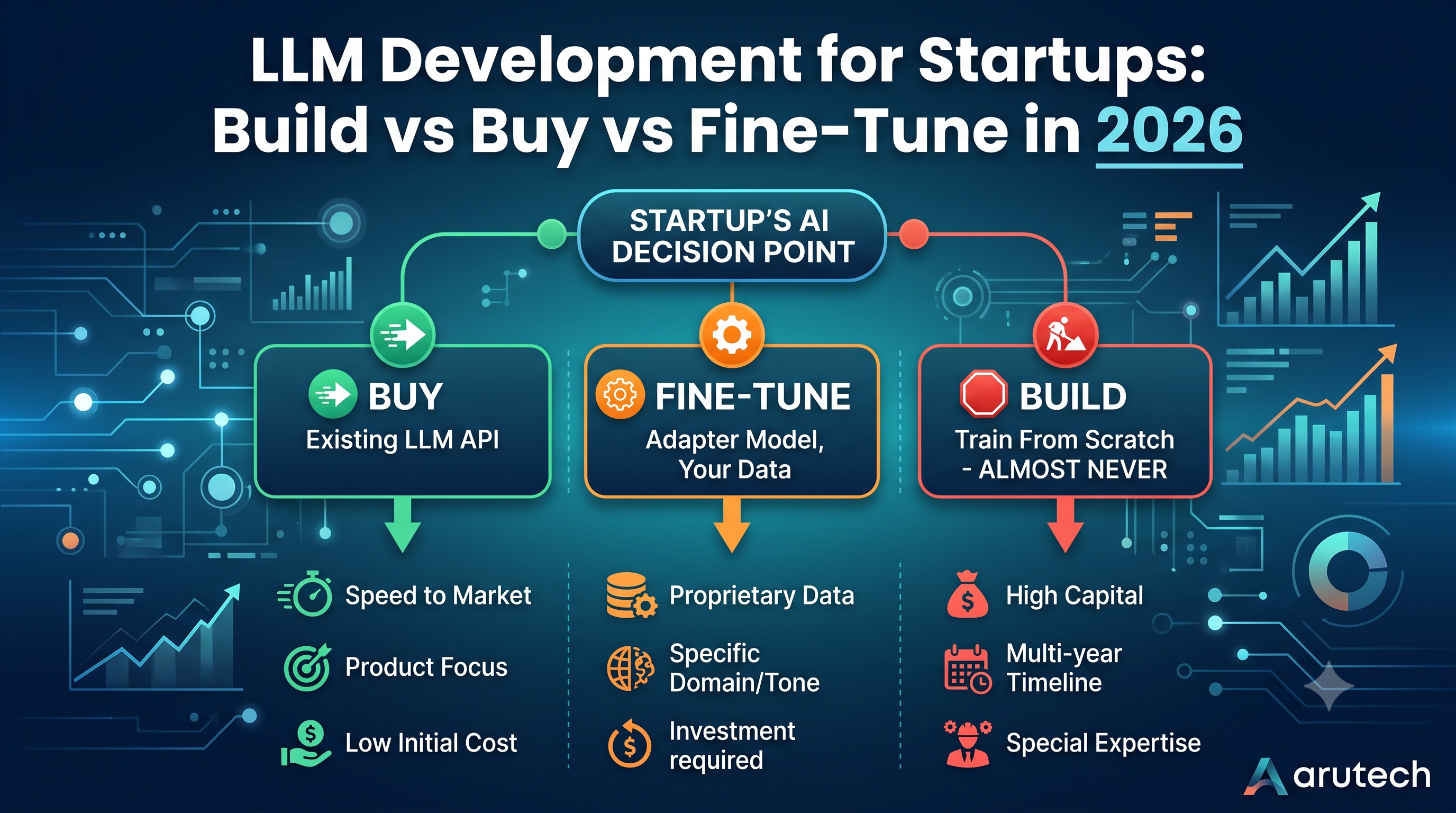
There are three real paths: buy (use an existing LLM API as-is), fine-tune (adapt an existing model to your specific data or behavior), and build (train or heavily customize a model from the ground up). Almost no early-stage startup should choose the third option, and understanding why is the fastest way to avoid a very expensive mistake.
Option 1: Buy (Use an Existing LLM API)
This means calling an existing provider's API (OpenAI, Anthropic, Google, or similar) directly, often combined with prompt engineering, RAG (retrieval-augmented generation), and good product design around it.
When this is the right call:
- You're validating a product idea and need to move fast
- Your use case doesn't require deep, proprietary domain behavior the general model can't already approximate
- You don't yet have a large, high-quality dataset that would meaningfully improve on a general model
- Cost predictability matters less right now than speed to market
The honest tradeoff: you're building on infrastructure you don't control, and your differentiation has to come from your product, data, and workflow — not from "we have an AI model." For the overwhelming majority of startups in 2026, this is the correct starting point.
Option 2: Fine-Tune
Fine-tuning takes an existing base model and further trains it on your specific data, so it performs better on your particular task, tone, or domain, without training a model from scratch.
When this is the right call:
- You have a genuinely large, high-quality, proprietary dataset that reflects the specific behavior you want
- General models consistently underperform on your specific task despite good prompting and RAG
- You need consistent output in a specific format, tone, or domain vocabulary that prompting alone struggles to enforce reliably
- You've already validated the product and are now optimizing performance and cost at scale
The honest tradeoff: fine-tuning adds real engineering and data-preparation overhead, and it needs to be redone as your data or requirements evolve. It's a meaningful investment, not a quick toggle — appropriate once you know exactly what you're optimizing for, not while you're still exploring the problem space.
Option 3: Build (Train Your Own Model From Scratch)
This means training a foundation model yourself, which requires enormous compute resources, large training datasets, and specialized ML infrastructure expertise.
When this is the right call, honestly: almost never, for an early-stage startup. The cost and expertise required to train a competitive foundation model from scratch is well beyond what nearly any startup should spend its early capital on. This path exists for a small number of companies whose core product is the foundation model itself — not for startups building a product on top of AI capability.
If you're being pitched "we'll build you a custom model from scratch" by a vendor for a typical product feature, that's a signal worth questioning carefully — both on cost grounds and on whether the vendor understands what your stage of company actually needs.
A Practical Decision Framework
Ask these questions, in order:
- Have you validated the core product yet? If no — buy. Don't invest in fine-tuning or custom model work before you know the product resonates.
- Is a general model, combined with good prompting and RAG on your own data, actually failing at the task? If it's performing adequately, there's no need to fine-tune yet — the ROI isn't there.
- Do you have a large, high-quality, proprietary dataset that a general model can't replicate? If yes, and general-model performance genuinely isn't good enough, fine-tuning becomes worth evaluating.
- Is your company's entire value proposition the model itself, not a product built on top of one? If no, training a model from scratch is very unlikely to be the right investment at your stage.
Cost and Timeline Reality Check
- Buy: Can be live in days to a few weeks, with costs scaling primarily with usage.
- Fine-tune: Typically weeks to a couple of months, including data preparation, with meaningful upfront investment plus ongoing maintenance as your data evolves.
- Build: Months to years, with capital requirements far beyond what most startups raise in an early round.
Most successful AI-powered startups in 2026 spend the majority of their early engineering effort not on the model layer at all, but on the product experience, data pipeline, and workflow integration around a "bought" model — that's usually where the actual differentiation and defensibility comes from.
Common Mistake: Confusing "Custom AI" With "Custom Model"
You don't need a custom-trained model to have a genuinely custom AI product. A well-designed system combining a general LLM, your own data through RAG, thoughtful prompt and context engineering, and a tightly built product experience can feel completely custom to your users — without the cost and maintenance burden of an in-house model. Save the fine-tuning and custom-model conversations for once you have clear, data-backed evidence that a general model is the actual bottleneck.
How Arutech Helps Startups Make This Call
Arutech's AI & Generative AI Development team starts every engagement by scoping which of these three paths actually fits your stage and use case — not by defaulting to whichever is most expensive to build. Most early-stage engagements start with a well-architected "buy" approach using RAG and strong prompt/context engineering, with a clear path to fine-tuning later if the data and performance case for it actually emerges.
Explore Arutech's AI & Generative AI Development services →
FAQ
Is fine-tuning always better than using a general LLM API?
No. Fine-tuning only pays off when you have a large, high-quality proprietary dataset and a demonstrated performance gap that prompting and RAG can't close. Many products never actually need it.
How much data do I need before fine-tuning makes sense?
There's no fixed number, but it needs to be enough high-quality, representative examples to meaningfully shift model behavior — a small or inconsistent dataset usually isn't enough to justify the investment.
Should an early-stage startup ever train its own foundation model?
Almost never, unless the foundation model itself is the core product. The compute and expertise required make this the wrong use of early capital for nearly all startups.
What's the biggest mistake startups make with LLM development?
Investing in fine-tuning or custom model work before validating that a general model, combined with good product design and RAG, genuinely can't do the job.
Want to work with Arutech?
We build AI, apps, and digital marketing strategies that drive real results.
Get a Free Consultation