RAG for Business: A Non-Technical Guide to Custom AI on Your Own Data
Why can ChatGPT answer general questions confidently but get your company's policies wrong? RAG is the technology that fixes this — here's what it is, in plain English, and why your business needs it.
Introduction
Ask a general-purpose AI model a question about your own company's return policy, your internal pricing tiers, or last quarter's sales figures, and you'll usually get one of two things: a confident-sounding wrong answer, or an honest "I don't have access to that." Neither is useful for a business that wants AI to actually work with its own information.
RAG — Retrieval-Augmented Generation — is the technology that solves this, and it's the foundation behind almost every serious business AI chatbot, assistant, or agent built in 2026. This guide explains what it is without the engineering jargon, and why it matters if you're considering any kind of custom AI for your business.
The Problem RAG Solves
Large language models are trained on a huge amount of general text, but that training has two limits that matter for business use:
- It has a cutoff. The model doesn't know about anything that happened after its training data ends, and it definitely doesn't know your company's information — your product catalog, your internal documents, your latest pricing.
- It can "hallucinate." When a model doesn't know something, it doesn't always say so. Sometimes it generates a plausible-sounding but incorrect answer instead.
For a general chatbot, that's an annoyance. For a business tool answering customer questions, processing internal documents, or supporting decisions, it's a real risk — a confidently wrong answer about a refund policy or a compliance requirement can cause real damage.
What RAG Actually Does
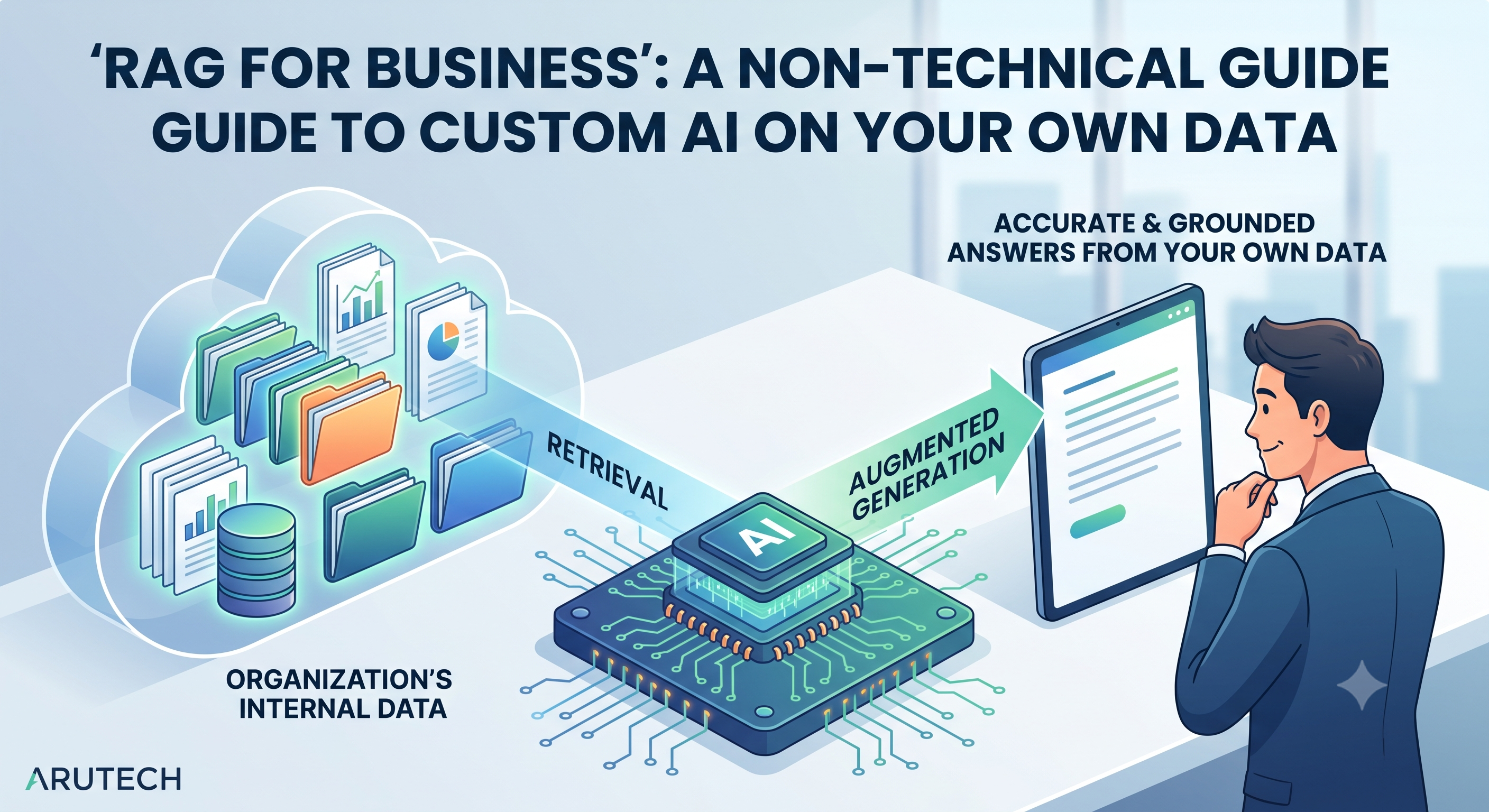
RAG connects the AI model to your actual, current information at the moment it answers a question, instead of relying only on what it learned during training. In plain terms, the process looks like this:
- Your documents, policies, product data, or knowledge base are stored in a way the system can quickly search through (this is the "retrieval" part).
- When someone asks a question, the system first searches that stored information for the most relevant pieces.
- Those relevant pieces are handed to the AI model along with the original question, so it generates its answer grounded in your actual data — not just its general training.
The result is an AI system that can say "according to your return policy, updated last month..." instead of guessing based on generic knowledge of how most companies handle returns.
Why This Matters for Your Business
- Answers stay current. Update your source documents, and the AI's answers update with them — no need to retrain the entire model every time a policy changes.
- Answers are grounded, not guessed. The system pulls from your actual information rather than generating something that merely sounds right.
- You keep control of your data. Your proprietary information stays in your own storage system; it's retrieved when needed rather than baked permanently into a model.
- It's far cheaper than fine-tuning. Training a custom model on your data from scratch is expensive and slow to update. RAG achieves a similar practical result — AI that "knows" your business — at a fraction of the cost and much faster iteration.
Where the "Vector Database" Fits In
You'll often hear RAG mentioned alongside "vector databases." This is simply the technology used to make the retrieval step fast and relevant. Instead of a basic keyword search, your documents are stored in a way that lets the system find information based on meaning, not just exact word matches — so a question phrased differently than your source document still finds the right answer. You don't need to understand the technical details to use RAG, but it's worth knowing that a well-built vector search layer is what separates a RAG system that finds the right information reliably from one that misses it half the time.
Common Business Use Cases for RAG
- Customer support: answering questions grounded in your actual product documentation, policies, and FAQs, updated as they change.
- Internal knowledge assistants: letting employees ask natural questions and get answers pulled from company wikis, SOPs, and past decisions, instead of searching through folders.
- Sales enablement: giving a sales team instant, accurate answers about product specs, pricing tiers, and competitive positioning based on the latest internal materials.
- Compliance and legal reference: surfacing the exact relevant clause or policy from a large set of documents, with a clear source, rather than a paraphrased guess.
- Onboarding and training: new employees getting accurate answers to process questions without waiting on a colleague or searching scattered documentation.
What to Ask a RAG Development Company Before You Hire
- How is the retrieval system kept up to date as your documents change?
- Can the system tell you where an answer came from (source citation), not just give a bare answer?
- What happens when the system can't find a confident answer — does it say so, or does it guess?
- How is sensitive or confidential information handled and secured within the retrieval layer?
- Is this a one-time build, or does the vendor support you as your document set grows and changes?
Getting RAG Right Is What Separates a Useful AI Tool From a Risky One
A poorly built RAG system can retrieve irrelevant information, miss the most current version of a document, or still let the model wander off and generate an ungrounded answer. A well-built one consistently surfaces the right information and is honest about the limits of what it knows. That difference in execution — not the underlying concept — is what determines whether your business AI is actually trustworthy.
How Arutech Builds RAG Systems
Arutech's AI & Generative AI Development team builds RAG systems with careful attention to retrieval accuracy, source citation, and how your data is secured throughout the pipeline — whether it's powering a customer-facing chatbot, an internal knowledge assistant, or the memory layer behind a full AI agent. We design the system to stay current as your documents change, without needing a full rebuild every time your business does.
Explore Arutech's AI & Generative AI Development services →
FAQ
Is RAG the same as fine-tuning an AI model?
No. Fine-tuning changes the underlying model itself using your data, which is slower and more expensive to update. RAG keeps the model as-is and retrieves relevant information at the moment of the question, making it much faster and cheaper to keep current.
Does RAG mean my company's data is used to train someone else's AI model?
Not if it's built correctly. In a proper RAG setup, your data is stored and retrieved for your own use — it isn't fed back into training a shared, general-purpose model. Always confirm this explicitly with any vendor.
How much data do I need for RAG to be useful?
There's no strict minimum. Even a modest set of well-organized documents (a policy handbook, a product catalog, a support FAQ) can meaningfully improve the accuracy of an AI system compared to relying on general training alone.
Can RAG completely eliminate incorrect AI answers?
It significantly reduces them by grounding answers in your actual data, but it doesn't guarantee perfection. A well-built system should also be honest when it can't find a confident answer, rather than guessing.
Want to work with Arutech?
We build AI, apps, and digital marketing strategies that drive real results.
Get a Free Consultation